
Isomers of Ascorbic Acid D and L Separation by HPLC - AppNote
February 10, 2022
/
/
/
/
Date: 10-FEB-2022 Last Updated: 02-APR-2026
An Analysis of Vitamin C
Click HERE for Column Ordering Information.
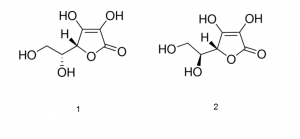
Column: Cogent Diamond Hydride™, 4 µm, 100 Å
Catalog No.: 70000-15P
Dimensions: 4.6 x 150 mm
Mobile Phase: 100% Acetonitrile + 0.1% Formic Acid
Flow Rate: 1.0mL / minute
Injection Volume: 1uL
Detection: UV 254 nm
Injection vol.: 1 μL
Sample Preparation: D- Isoascorbic Acid and L- Ascorbic Acid in 1.0 mg / mL in diluent of 50% Acetonitrile / 50% DI Water (v/v)
t0: 1.8 minutes
Note: Vitamin C exists in different stereochemical forms. The one your body actually uses is L‑ascorbic acid, the naturally occurring form found in fruits and vegetables that helps prevent scurvy.

An Analysis of Vitamin C
Click HERE for Column Ordering Information.
This straightforward method provides effective retention and good resolution for L‑ascorbic acid and erythorbic acid, two stereoisomeric acidic compounds with identical molecular formulas and closely matching physicochemical properties. Notably, strong separation is achieved even though both analytes exhibit very low hydrophobicity (log P ≈ −1.6),
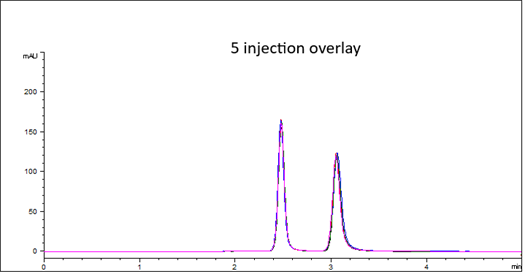
Peaks:
1. D- Isoascorbic acid
2. L- Ascorbic acid
Column: Cogent Diamond Hydride™, 4 µm, 100 Å
Catalog No.: 70000-15P
Dimensions: 4.6 x 150 mm
Mobile Phase: 100% Acetonitrile + 0.1% Formic Acid
Flow Rate: 1.0mL / minute
Injection Volume: 1uL
Detection: UV 254 nm
Injection vol.: 1 μL
Sample Preparation: D- Isoascorbic Acid and L- Ascorbic Acid in 1.0 mg / mL in diluent of 50% Acetonitrile / 50% DI Water (v/v)
t0: 1.8 minutes
Note: Vitamin C exists in different stereochemical forms. The one your body actually uses is L‑ascorbic acid, the naturally occurring form found in fruits and vegetables that helps prevent scurvy.